
Best Home Theatre Speaker Placement Tips for Indian Homes
Home theatre speaker placement means positioning your front, centre, surround, height, and subwoofer speakers at precise angles and distances relative to the primary listening seat. So that sound arrives at the right time from the right direction to create a convincing, immersive experience. Get placement wrong, and even a ₹15 lakh speaker system will sound worse than a ₹2 lakh system placed correctly.
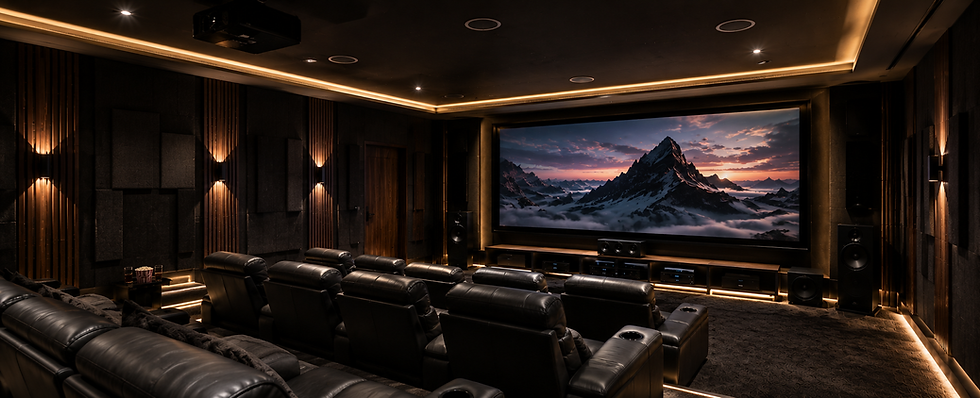
We design and install home theatre systems across Delhi-NCR, Noida, Gurgaon, and Jaipur — and poor speaker placement is the single most common reason a newly installed theatre underperforms. This guide covers placement recommendations for 5.1, 7.1, and Dolby Atmos setups — following CEDIA's RP-1.1 guidelines (finalized 2025), the international industry standard for loudspeaker placement in professional AV installations — along with how Indian room shapes affect these recommendations, and the mistakes we see most often.
Why Does Speaker Placement Matter More Than Speaker Brand?
Most homeowners spend months choosing brands and almost no time on placement — but acoustic science is clear: a ₹50,000 speaker placed correctly will outperform a ₹2,00,000 speaker placed incorrectly, because placement determines how sound interacts with the room itself.
The three things placement controls:
Arrival time — sound from each speaker should arrive at the listening position at the correct delay relative to the others (this is what creates the illusion of sound coming from a specific direction)
Imaging — where instruments, voices, and effects appear to "sit" in the soundstage
Room interaction — how much reflected sound from walls, ceiling, and floor reaches the listener, and when
This is also why acoustic treatment (absorption panels, diffusers) and speaker placement work together — and why we always assess a room before recommending a speaker layout.
What Are the Recommended Positions for a 5.1 Surround Sound Setup?
A 5.1 system has five speakers and one subwoofer. Recommended placement per speaker (based on CEDIA RP-1.1 guidelines):
Speaker | Recommended Position | Height | Suggested Angle from Listening Seat |
Front Left / Right | Either side of the screen | Tweeter at ear level when seated | 22–30° off centre |
Centre | Directly above or below the screen | As close to screen height as possible | On-axis (0°) |
Surround Left / Right | To the sides or slightly behind | Slightly above ear level (60–90cm above) | 90–110° off centre |
Subwoofer | Front corner of room (usually) | Floor level | N/A — bass is omnidirectional |
The 30-degree guideline for front speakers: Your front left and right speakers should form a roughly equilateral triangle with your primary listening seat — if you're sitting 3 metres from the screen, the left and right speakers should be approximately 3 metres apart.
Centre channel: This is the most important speaker in a home theatre — dialogue comes primarily from here. It must be on-axis with the listening seat (not angled upward or downward), which is why TV console height and screen mounting height matter when planning the theatre room layout.
What Are the Recommended Positions for a 7.1 Setup?
A 7.1 system adds two rear surround speakers behind the listening position:
Speaker | Recommended Position | Suggested Angle |
Front L/R | Same as 5.1 | 22–30° |
Centre | Same as 5.1 | 0° |
Side Surround L/R | Directly to the sides | 90° |
Rear Surround L/R | Behind the listening seat | 135–150° |
Subwoofer | Front corner | Floor |
The key addition in 7.1 is separating the "side" surround from the "rear" surround — this only makes sense if the room is large enough for the listening seat to be well away from the rear wall (at least 1.5–2 metres). In smaller Indian rooms (under 16 x 12 feet), a 5.1 layout often sounds better than a 7.1 because the rear speakers end up too close to the listening seat to be effective.
How Does Dolby Atmos Change Placement - and What Are the Ceiling Speaker Recommendations?
Dolby Atmos adds height channels — speakers that deliver sound from above, creating a full three-dimensional audio sphere. The most common Atmos configurations in Indian homes are 5.1.2 and 7.1.4:
Atmos Format | What It Means | Ceiling Speakers Needed |
5.1.2 | 5 traditional + 1 sub + 2 height | 2 ceiling speakers (above the seating area) |
7.1.2 | 7 traditional + 1 sub + 2 height | 2 ceiling speakers |
7.1.4 | 7 traditional + 1 sub + 4 height | 4 ceiling speakers (front and rear pairs) |
Ceiling speaker placement for Atmos:
For a 5.1.2 or 7.1.4 front pair: position ceiling speakers above and slightly in front of the listening seat, angled toward it — typically at a 45° angle between the listener and the front screen
For a 7.1.4 rear pair: position above and slightly behind the listening seat, mirroring the front pair
Avoid placing ceiling speakers directly over the seating position — this pulls height effects straight down rather than creating the overhead "dome" effect Atmos intends
In-ceiling speakers (flush-mounted) are strongly preferred over upward-firing Atmos modules for dedicated home theatres — the placement precision is higher, and the result is significantly better.
How Does Room Size and Shape Affect Placement in Indian Homes?
Indian home theatre rooms often face specific constraints that affect ideal placement:
False ceilings: Most Indian luxury homes have false ceilings, which typically sit at 9–10 feet. This is actually ideal for Atmos — flush ceiling speakers can be installed in the false ceiling during construction, which is far cleaner than surface-mounted alternatives
Rectangular rooms: Most Indian bedrooms and dedicated theatre rooms are rectangular, which suits 5.1 and 7.1 layouts well — long-wall seating (screen on the short wall) generally gives better surround imaging than short-wall seating
Open-plan living rooms: Many Indian villas have large open-plan ground floors where a dedicated theatre isn't practical — here, in-wall architectural speakers for a left/right/centre setup plus a subwoofer typically work better than a full surround layout, which requires room boundaries to be effective
Room within a room acoustics: True dedicated theatre rooms in Indian villas often benefit from acoustic wall panels at the first reflection points (side walls at ear level) — without this, a hard-wall room reflects so much sound that placement precision is partially wasted
What Are the Most Common Home Theatre Placement Mistakes We See?
1. Placing surrounds too low — The most frequent error. Surround speakers mounted at the same height as the front speakers (ear level when seated) create a "flat" soundfield with no sense of envelopment. Surrounds should be 60–90cm above seated ear level, angled slightly downward toward the listening position.
2. Centre channel angled upward from below the screen — When a centre speaker is placed below the screen and angled upward (because it's the only way to aim it at the listener), dialogue sounds like it's coming from the floor. A correctly mounted centre is level or very slightly angled, not pointing upward.
3. Subwoofer placed in the middle of the room — Bass output is strongest in room corners (boundary gain effect). Placing a subwoofer in the centre of a wall or, worse, in the middle of the room wastes significant bass output. A front corner placement, or using the "subwoofer crawl" method (walking around the room while a test tone plays) to find the highest output position, makes a significant difference.
4. Rear surrounds too close to the listening seat — In a small room, placing rear surrounds only 1 metre behind the seat means the listener hears those speakers as a distinct, localized source rather than as ambient surround sound. Either increase the distance or switch to a 5.1 layout.
5. Ignoring room treatment — No amount of precise placement compensates for a room with no acoustic treatment. Hard parallel walls create flutter echo that smears high-frequency detail. At minimum, a thick carpet, fabric seating, and curtains on rear walls significantly improve the result before dedicated panels are added.
A Real Project: Dolby Atmos 7.1.4 in a Dedicated Theatre at Ozone City, Aligarh
In a dedicated home theatre room at the Ozone City project in Aligarh (75,000 sq ft luxury farmhouse), we specified and installed a full 7.1.4 Dolby Atmos layout — TruAudio in-ceiling speakers for the four height channels integrated into the false ceiling, front L/R/C in-wall speakers flanking a 4K motorised projection screen, side and rear surrounds mounted at the 110° and 145° positions, and dual subwoofers in the front corners for even bass distribution across the room.
The critical decision in that project was mounting height for the side surrounds — the room had a 10-foot false ceiling and fixed seating at a specific distance, which meant the 90° side surrounds needed to be placed at exactly 1.2 metres above seated ear level to hit the recommended angle. Getting this right required coordination between the theatre room design phase and the false ceiling contractor before wiring was run — a reminder that speaker placement must be decided before the room is finished, not after.
What Does a Home Theatre Setup Cost in India?
Setup | Speaker Count | Approx. Cost (Speakers + Installation) |
5.1 in-wall/in-ceiling | 6 speakers | ₹2,50,000 – ₹8,00,000 |
7.1 dedicated theatre | 8 speakers | ₹5,00,000 – ₹15,00,000 |
7.1.4 Dolby Atmos | 12 speakers | ₹10,00,000 – ₹35,00,000+ |
Full cinema room with acoustic treatment | 12+ speakers + panels | ₹20,00,000 – ₹80,00,000+ |
Cost varies significantly by brand (TruAudio, Bowers & Wilkins, Sonance), room size, acoustic treatment requirements, and whether the project is new construction (cleaner, lower cost) or retrofit. For a detailed breakdown, see our home theatre services page.
FAQs
Does it matter whether I use in-ceiling or on-wall speakers for a home theatre?
For a dedicated theatre room, in-ceiling and in-wall speakers are strongly preferred — they allow precise placement without visible hardware, and the installation quality is higher when done during construction. On-wall speakers are a retrofit alternative when in-wall placement isn't possible.
Can I get good surround sound in a small room (under 12 x 10 feet)?
A 5.1 layout is usually the most practical for small rooms. A 7.1 setup requires enough distance between the side and rear surround positions to be effective — in a very small room, the rear surrounds end up too close to the listener. A well-placed 5.1 system will outperform a poorly-placed 7.1 in the same space.
What's the minimum ceiling height for Dolby Atmos in an Indian home?
9 feet is workable for Dolby Atmos with ceiling speakers, though 10 feet or higher gives better results. Lower ceilings reduce the perceived "height" of overhead effects. Below 8.5 feet, Atmos height channels often add less value than a well-tuned 7.1 floor-level system.
Should I match speaker brands across a home theatre setup?
For front L/R/C speakers (which handle most of the critical stereo and dialogue content), matching the same brand and ideally the same range ensures consistent tonal character. Surround and height speakers are less critical to match exactly, though staying within the same brand family helps.
How is a KNX-integrated home theatre different from a standard setup?
In a KNX-integrated home theatre, the projector, screen, audio processor, and all lighting are controlled from one scene — pressing "Movie Time" simultaneously lowers the screen, dims the room lighting to a pre-set level, closes blinds, and switches the AV system to the correct input. No separate remotes or manual steps are needed.
After Placement: Calibration Workflow
Physical placement is only half the job. Once speakers are correctly positioned, calibration ensures they perform as one cohesive system. CEDIA's RP-1.1 recommends a structured four-step calibration sequence — and the order matters:
Level calibration — each speaker matched to the same SPL (sound pressure level) at the primary listening position using a calibration microphone
Crossover frequencies — set correctly per speaker type, particularly the subwoofer handoff point to the main speakers
Timing alignment — delays adjusted so sound from all speakers arrives at the listening seat simultaneously, regardless of physical distance differences
EQ correction — room acoustic issues corrected after placement and timing are confirmed, not before (applying EQ to compensate for poor placement is always less effective than fixing placement first)
Most AV receivers include an automatic calibration system (Audyssey, YPAO, MCACC) that runs through these steps using a microphone at the listening position — a useful starting point that we typically refine manually for dedicated theatre installations.
Conclusion
Speaker placement is the highest-return investment in any home theatre setup — more impactful, per rupee, than upgrading speaker brands. Getting placement right requires deciding positions before construction is finished, coordinating with the false ceiling and wiring contractor at the right stage, and factoring in room acoustics from the start rather than after. If you're planning a home theatre in Noida, Delhi NCR, or Gurgaon and want placement designed correctly from day one, talk to our team for a free consultation.
Originally Published Content:- https://www.techvault.co.in/blog/article/best-home-theatre-speaker-placement-tips-india


Comments